Ready.gov's guideline is to store at least a several-day supply of non-perishable food. That is the first milestone, and our guide to the first 10 things every household should have covers it.
Two weeks is the next one. A booklet from FEMA and the American Red Cross, Food and Water in an Emergency, puts it this way: "Even though it is unlikely that an emergency would cut off your food supply for two weeks, consider maintaining a supply that will last that long." The booklet dates from 2004, so we treat two weeks as a sensible goal, not a rule.
Start with the meals you already eat
The same booklet has good news for beginners. It says you may not need to go out and buy foods to prepare an emergency food supply, because you can use the canned goods, dry mixes and other staples on your cupboard shelves.
Ready.gov's advice is just as plain: choose foods your family will eat. The FEMA booklet explains why. Familiar foods, it says, lift morale and give a feeling of security in times of stress.
So start with a list of meals instead of a shopping list:
- Write down the breakfasts, lunches and dinners your household already makes mostly from the cupboard.
- Pick the ones that still work with the power out.
- Count how many of those meals you could make today.
- Buy the difference a little at a time.
Fourteen days sounds like a lot. In practice it is four or five meals your family likes, repeated. Nobody minds a favorite dinner three times in two weeks.
What to stock
Ready.gov's list of suggested emergency food supplies is ordinary grocery food:
- Ready-to-eat canned meats, fruits and vegetables
- Protein or fruit bars
- Dry cereal or granola
- Peanut butter
- Dried fruit
- Canned juices
- Non-perishable pasteurized milk
- High-energy foods
- Food for infants
- Comfort or stress foods
It adds two reminders. Remember any special dietary needs, and be sure to include a manual can opener and eating utensils. The FEMA booklet adds one more: don't forget nonperishable foods for your pets.
Notice the last item on the list. Comfort food is on the official list for a reason, so include a few treats your family enjoys.
Think no-cook first, low-cook second
Ready.gov says to stock canned foods, dry mixes and other staples that do not require refrigeration, cooking, water or special preparation. It helps to sort your pantry into two groups.
No-cook food can be opened and eaten. Ready.gov notes that commercially canned food may be eaten out of the can without warming. Cereal, peanut butter, crackers, bars and dried fruit belong here too. Aim to have most of your 14 days in this group.
Low-cook food needs heat, water or both. Pasta, rice and dry mixes are examples. They are worth keeping, because they are foods most families already eat. They depend on having a safe way to cook and enough water, so they should not be the whole plan.
Ready.gov says alternative cooking sources can be used in an emergency, including candle warmers, chafing dishes, fondue pots or a fireplace. If you heat food in its can, Ready.gov says to remove the label and open the can before heating. Its food page lists the steps.
Count the water for cooking
Food and water plans are linked. Ready.gov's guideline is one gallon of water per person per day, for drinking and sanitation. The FEMA booklet notes that you will also need water for food preparation.
Every pot of pasta or rice comes out of that same supply. If your pantry leans on low-cook food, store extra water to match. Our guide to how much water your family needs shows the math.
Canned food helps here. The CDC lists liquid from canned fruit and vegetables as a source of clean water inside the home. The FEMA booklet suggests that if your water supply is limited, you avoid salty foods, since they will make you thirsty, and eat canned foods with high liquid content instead.
Where and how to store it
Your pantry does not need a special room. It needs the right conditions:
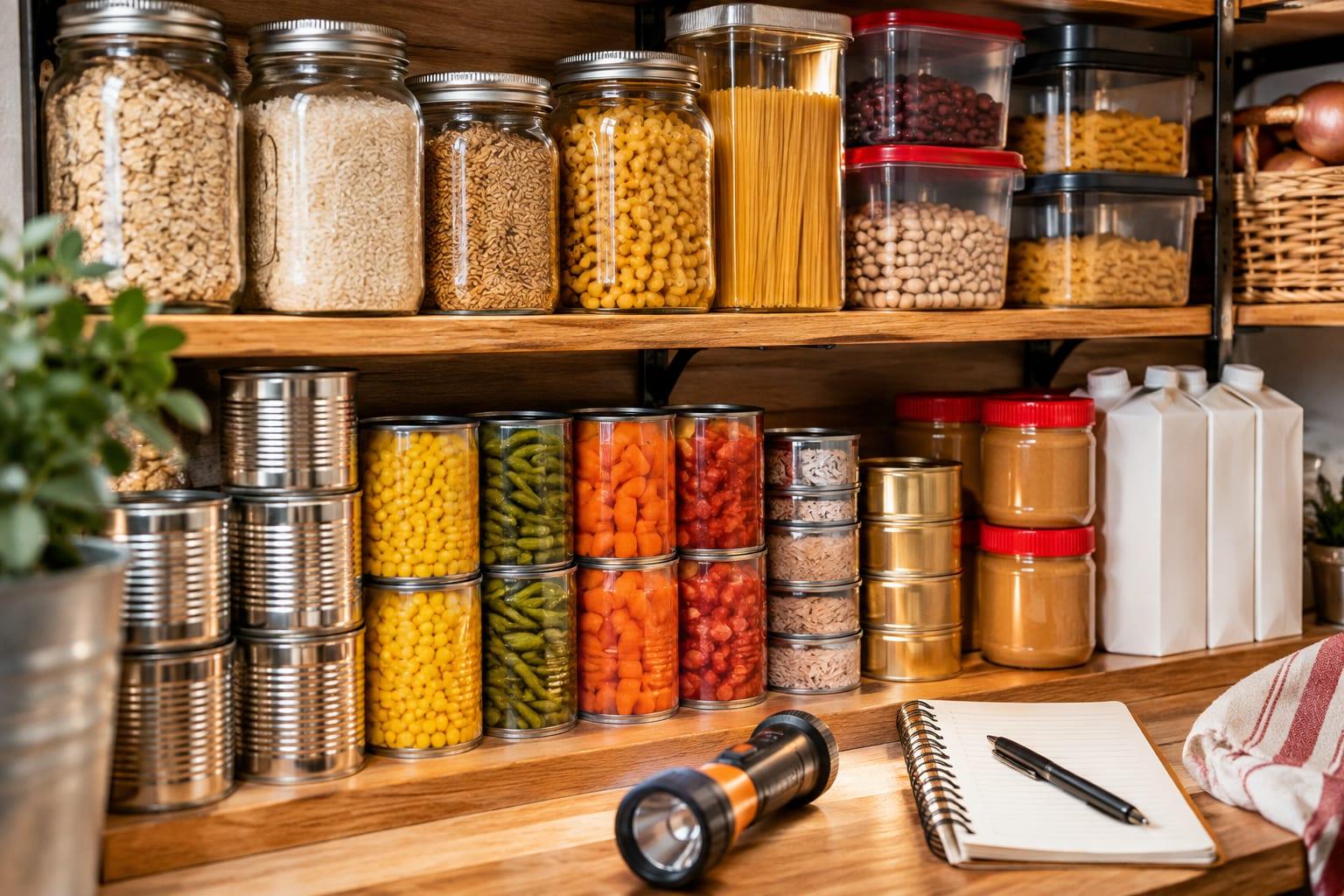
- Cool and dry. Ready.gov says to keep canned food in a cool, dry place. The FEMA booklet adds a dark area if possible.
- Sealed. Ready.gov says to store boxed food in tightly closed plastic or metal containers. The FEMA booklet suggests emptying open packages of sugar, dried fruits and nuts into screw-top jars or air-tight canisters, for protection from pests.
- Away from chemicals. The FDA says not to store non-perishable foods near household cleaning products and chemicals.
- Above flood level. The FDA says to store food on shelves that will be safely out of the way of contaminated water in case of flooding.
What to look for: plastic or metal containers with lids that close tightly, in a size that fits your shelf. A kitchen cupboard, a hall closet or a shelf in a dry basement can all work.
Use it so nothing expires
A pantry you eat from stays fresh. The FEMA booklet's advice is to check expiration dates and follow the practice of first-in, first-out. It says to place new items at the back of the storage area and older ones in front, and to date replacements with ink or marker.
It helps to know what the dates mean. The FDA says a "use by" date means the manufacturer recommends using the product by that date for the best flavor or quality, and that the date is not a food safety date. It names one exception. Infant formula and some baby foods must be used by the use-by date on the package.
The FEMA booklet gives general guidelines for replacing common foods:
- Use within six months: boxed powdered milk, dried fruit, and dry, crisp crackers.
- Use within one year, or before the date on the label: canned fruits, fruit juices and vegetables, canned condensed meat and vegetable soups, ready-to-eat cereals, peanut butter and jelly.
- May be stored indefinitely, in proper containers and conditions: white rice, dry pasta, salt and vegetable oils.
These guidelines are from 2004. Where the label gives a date, go by the label.
Build it a little at a time
You do not need one big shopping trip. Ready.gov suggests picking up an extra item that you use regularly each time you go to the grocery store.
Here is one way to pace it:
- First: cover three days of no-cook meals for everyone in the house.
- Next: stretch that to a week by buying food for one or two extra pantry meals on each trip.
- Then: keep going until you can count 14 days, and add low-cook staples for variety.
Our guide to prepping on $25, $50 or $100 a month shows how the pantry fits with everything else.
What to do this week
- Write down the meals your family already eats that come mostly from the cupboard.
- Count how many days of those meals you have on hand right now.
- Add food for one or two extra pantry meals to your next grocery trip.
- Put a manual can opener on the shelf with the food.
- Write the date on each item, and put new food behind the old.
- Check every can, and throw out any that are swollen, dented or corroded.
Where to go next
- Emergency Food Storage: Canned vs. Freeze-Dried vs. Dehydrated
- How Much Emergency Water Does Your Family Actually Need?
- Keeping Your Refrigerator and Freezer Safe During an Outage
- How to Start Prepping on $25, $50, or $100 a Month
Sources
- Ready.gov: Food
- Ready.gov: Build a Kit
- Ready.gov: Water
- Ready.gov: Low and No Cost Preparedness
- FEMA and American Red Cross: Food and Water in an Emergency (FEMA 477, August 2004)
- FDA: Are You Storing Food Safely?
- FDA: Food and Water Safety During Power Outages and Floods
- CDC: Keep Food Safe After a Disaster or Emergency
- CDC: How to Find Clean Water in an Emergency